
A primer on self-improving agent harnesses
With harness engineering becoming a main focus of AI engineering, new frameworks allow AI agents to write their own execution logic and optimize their performance.

While a lot of focus goes to advances in large language models (LLMs), the performance of an AI application is largely dictated by its runtime harness: the execution logic, system prompts, memory management, and tool configurations that connect a model to the real world.
Developers want custom behavior from their applications, but training a model from scratch or fine-tuning open-weight LLMs is too expensive and fraught with different complexities. For most engineers, the harness is the most accessible lever for control.
As new models drop rapidly, manually updating and crafting these harnesses per model scales poorly. Harness optimization has remained a manual, time-consuming chore.
Recent AI frameworks are reframing this constraint. Instead of relying on manual labor, these frameworks structure the harness so that AI agents can iteratively analyze, test, and optimize their own runtime environments.
The anatomy of an agent harness
A harness is the operating system for a model. The model provides raw reasoning, but the harness provides the system structure. Familiar examples of agent harnesses include Cursor, Aider, Cline, and Anthropic’s Claude Code.
The complexity of a modern harness was put on full display when the source code for Claude Code leaked in March 2026. Security researchers and developers analyzing the architecture discovered it was not a simple chat wrapper, but a sophisticated multi-agent orchestrated system. Instead of relying on a single agent to handle understanding, planning, and coding within one overloaded context window, the architecture separates planning from execution. A lead agent analyzes the request, while specialized subagents handle testing, documentation, and debugging in parallel.
This orchestration is tied together by an “agentic loop,” a continuous execution process where the model gathers context, takes a tool action, observes the result, and adjusts its approach before repeating. To manage all this without losing track of the user’s intent, the harness employs a highly structured memory and control system.
General-purpose harnesses like this work well out of the box. However, when developers want to optimize an agent for a highly specific application, they must adjust the harness at different levels. Because modern harnesses are deeply entangled, this manual process is fraught. A developer might tweak a prompt to fix one edge case, only to silently break the agent’s tool-calling loop in another task.
The Self-Harness framework
A framework called Self-Harness introduces an iterative, autonomous loop that lets AI agents improve their own scaffolding by mining execution traces. The framework works in three stages:
1. Weakness mining: The agent runs against an evaluation dataset and produces detailed execution traces, logging every tool call, error message, and response. It analyzes these logs to identify model-specific failure patterns rather than general software bugs.
2. Harness proposal: The agent acts as a proposer, generating minimal, targeted code or prompt modifications to the harness to fix the identified weakness.
3. Proposal validation: The updated harness undergoes strict regression testing. If a proposed edit fixes the target edge case but breaks a previously passing task, the edit is rejected. This prevents cascading failures across the system.
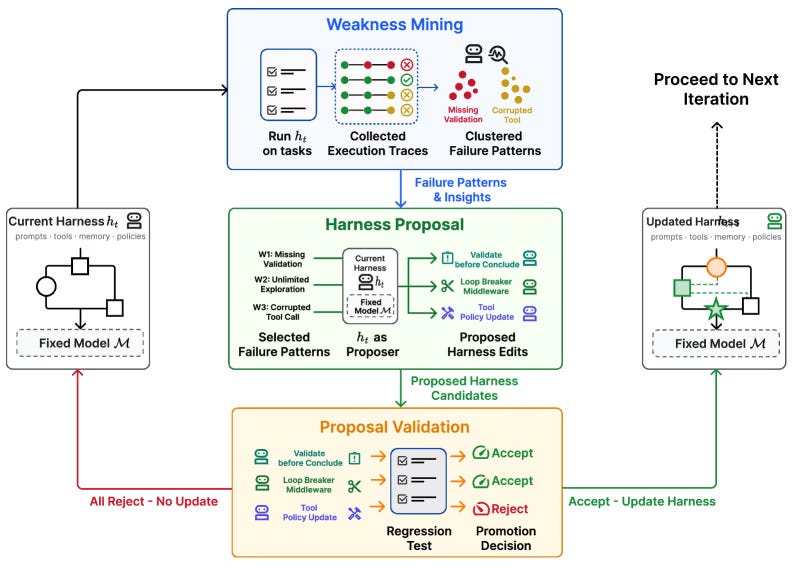
When tested on Terminal-Bench-2.0, the base model encountered frequent failures due to ambiguous file errors. Instead of a human writing a patch, the Self-Harness loop analyzed the failure traces and generated new executable rules. It introduced a strict command-retry discipline that forbade duplicate sequential commands, created a mechanism to force the agent to recreate missing artifacts upon encountering file errors, and added instructions to persist environment variables across shell sessions.
The framework yielded significant gains on standard benchmarks without touching model weights. For instance, MiniMax M2.5 jumped from a 40.5% to a 61.9% pass rate, receiving solutions tailored entirely to its unique performance profile.
Developers can apply this concept today without an official plug-and-play package. The execution path involves heavily instrumenting application trace logs, curating a validation dataset of core tasks, running the weakness mining phase using an external LLM to analyze the logs, and automating the evaluation gate to ensure updates do not introduce performance regressions.
Composable optimization with HarnessX
A separate framework developed by researchers at Xiaomi, called HarnessX, approaches the problem by treating the harness as a formal software artifact. It breaks agent behavior down into distinct components: context assembly, memory management, tool ecosystems, and control flow.
Every specific behavior is implemented as an independent processor. Much like Lego blocks, these processors plug into precise lifecycle hooks. This allows the system to swap, add, or remove components without breaking the surrounding pipeline.
HarnessX adapts these blocks using a trace-driven evolution engine called AEGIS, which operates as a four-stage multi-agent pipeline:
Digester: Analyzes execution traces to isolate exactly where the current harness failed.
Planner: Devises a high-level strategy to fix the architectural gap.
Evolver: Generates actual code-level edits to the specific harness processor and runs isolated tests.
Critic: Assesses the edits to detect reward hacking and uses a deterministic gate to reject updates that regress past performance.
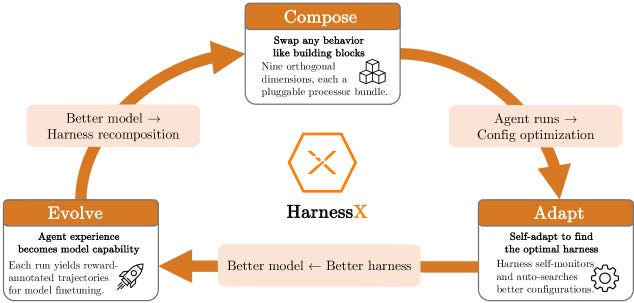
The standout feature of HarnessX is harness-model co-evolution. Optimizing only the harness hits a scaffolding ceiling if the underlying model lacks the reasoning capacity to use the new tools. Conversely, training only the model hits a training-signal ceiling if the harness never prompts it to use advanced capabilities.
HarnessX addresses this by interleaving harness evolution with model training via a shared replay buffer using cross-harness Group Relative Policy Optimization (GRPO). GRPO is a reinforcement learning algorithm that scores an AI’s output by generating multiple potential answers and evaluating how much better or worse each one is compared to the group’s average. Every time the harness improves its structural strategy, the model simultaneously learns to exploit that new configuration.
In experiments, this co-evolution proved effective. While harness evolution alone provided a 14.5% average gain across ALFWorld, GAIA, and SWE-bench Verified, adding model co-evolution yielded an additional 4.7% performance boost, breaking the individual capability ceilings of traditional agent deployment.
The researchers have open-sourced the codebase on GitHub. Developers can clone the repository, run the installation script, and define their agent’s scaffolding via YAML configurations.
The repository includes built-in integrations for third-party modules like MemPalace for long-term memory management. It also connects with distributed training frameworks like VERL, allowing engineering teams to implement harness-model co-evolution on their own local infrastructure.
Shifting paradigms in loop engineering and continual learning
These frameworks intersect directly with two major movements in production AI: loop engineering and continual learning.
Loop engineering is the design of agent systems around systematic, multi-step feedback loops rather than single-shot prompt-response structures. In practice, this often devolves into “loopmaxxing”: forcing agents to iterate endlessly inside an application session without clear optimization signals, which wastes tokens and compute.
Self-Harness and HarnessX shift the loop from the application runtime (the user session) to the meta-runtime (the developer’s deployment environment). The system optimizes its own code based on clear verifiable signals.
This directly enables continual learning, the practice of allowing AI systems to adapt to new data and changing environments over time without experiencing catastrophic forgetting, where a model wipes out its past capabilities to learn a new task.
By allowing agents to ingest environment execution traces and safely rewrite their scaffolding without altering foundational base-model weights, the application improves its behavior natively as it gathers more real-world information. The evaluation architecture acts as a seesaw, balancing new feature adaptation against strict regression testing to protect production stability.
Takeaways for developers: how roles are reshaping
The emergence of self-improving harnesses signals a clear shift in how AI applications will be built and maintained.
From prompt tweakers to feedback architects: The era of artisanal, manual prompt engineering might be coming to an end. Developers will spend less time patching individual tool calls and more time building the infrastructure, trace logging, and evaluation datasets that make agent self-improvement possible. The role shifts toward designing the systems that govern how an agent learns.
An alternative to pure scaling: Evolving the runtime interface proves that scaling massive foundation models is not the only path to better performance. In HarnessX testing, smaller, open-weight models like Qwen 9B gained the most from dynamic scaffolding improvements. This dynamic helps democratize agent capabilities, proving that sophisticated behavior does not strictly require the largest proprietary models.
Collaboration over replacement: As foundation models grow and absorb more base capabilities, the harness does not disappear; its scope expands to connect models to richer, more complex enterprise environments.
There is a pragmatic caveat. Automating the harness requires significant computational overhead during the optimization phase, often relying on frontier models to act as the meta-agent that rewrites the code. For engineering teams, the challenge shifts from manually writing execution logic to managing the multi-tier execution costs and validation gates of these self-correcting systems.
Great summary of an evolving area. I've long recommended to clients that they should work on the measurement and prompting of models rather than fine tuning, it seems this is becoming a type of software in its own right. Good call.
Very interesting and useful. For someone new to code how can we create a loop engineering platform any resources?